

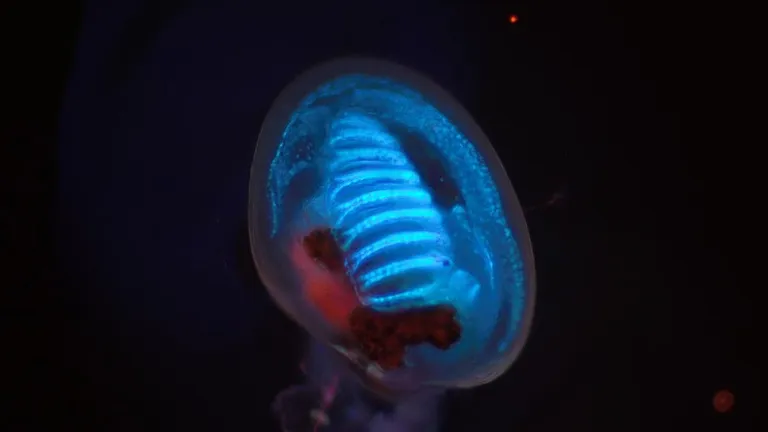
The Ecocost group from the Galician university achieves a development that will allow larvae to be cryopreserved during periods of high availability and restore overexploited banks.
Science delivers a new milestone to the fishing community in Vigo. The Ecocost group, from the Marine Research Center at the University of Vigo, has successfully preserved juvenile mussels up to one millimeter in size through freezing. This advancement, published in Scientific Reports, provides a scientific solution to address current challenges in aquaculture and the conservation of Mytilus galloprovincialis, a species whose production has significantly declined in recent years in Galicia, which accounts for 60% of global output.
Researchers Estefanía Paredes, Alba Lago, and Jesús Troncoso have developed an effective cryopreservation protocol for the mussel cultivated along the Galician coast. The method “allows larvae at advanced stages and juvenile marine organisms to be preserved by freezing,” according to the University of Vigo. Until now, this stage had been unattainable for the scientific community working in aquaculture.
The breakthrough was achieved through bioassays in which key factors for the growth of this mollusk, such as temperature, salinity, and feeding regime, were modified. This allowed the identification of optimal conditions for growth “and larval health,” which were then applied “as pretreatment strategies prior to freezing.” The researchers based their approach on the hypothesis that the larger the individual, the higher its chances of surviving cryopreservation.
Initially, the Ecocost group applied the preservation protocol to larvae between one and three days old and later refined the challenge to include more advanced and complex larval stages (up to 26 days), eventually extending it to juveniles (between 40 and 45 days). In one of these attempts, they succeeded in preserving a marine organism measuring one millimeter in size.
“Research on mussels is very important because it involves a species of great interest to Galician society and offers the possibility of using it as a model animal to advance studies in other species, such as clams or cockles,” explains Estefanía Paredes, one of the authors of this preservation milestone. Given the strong dependence of global production of this bivalve on natural seed sources (mussels, in this case), the advancement achieved by the University of Vigo center is a useful tool to “preserve larvae and juveniles during periods of high availability, reduce dependence on seasonal mussel recruitment, conserve valuable genetic lines, and support the restoration of overexploited natural banks,” the researchers note.
The Marine Research Center of Vigo highlights, as a key finding of this unprecedented development, the confirmation that pre-freezing feeding is not harmful. On the contrary, “it improves survival, size, and morphological normality of the organisms, contradicting previous ideas about the risk of ice crystal formation in full digestive tracts,” the researchers explain.
In Hanover
On June 21, the team of Galician scientists will present the results of this technique for mussel farming at the Cryobiology Society congress in Hanover. The research is supported by Next Generation funds.